The Oven has baked its last loaf. This blog is no longer being updated.

My cooking videos appear at youtube.com/janeragavan

I write on food at star2.com

Julia egg project: Scrambled

Monday, August 23, 2010

Fluff piece: Scrambled eggs with herbs.
Soufflés wait for no one... and neither do eggs cooked any other way.

My review of Mastering the Art of French Cooking (Vol. 1) by Julia Child, Louisette Bertholle and Simone Beck for The Star is out today (the link to the published page will be up soon is now up; click here) and as an extension to the two recipes that were published, I tried all the recipes in the egg chapter since it wasn't very long. Child et al concentrated on poaching, shirring, baking, scrambling and omelette making. I will post about them over the next few days.

I decided to start with the method that I considered the easiest: Scrambling. I've reproduced the recipe as it appears in the book but I only used 2 eggs since I had many more recipes to test. I remember making scrambled eggs in Domestic Science class and milk being added to the beaten eggs before they went into the saucepan and I have been making scrambled eggs like that since my school days. They always seemed to come out a bit mushy. I would often overcook them because I didn't like them watery, which would result in some kind of rubberised custard. After reading the Julia Child's instructions, I now know not to add any liquid to the eggs.

I must have done something right for a change because with this recipe, the eggs came out nice and fluffy. I think it also had something to do with the free-range eggs I used. So that's one egg recipe down and a few more to go.
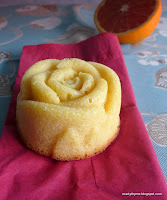
I posted about the Orange and Almond Spongecake from the book some time ago. Click on the picture on the right for the recipe.

TOMORROW: Poached eggs


SCRAMBLED EGGS
Oeufs Brouillée
Scrambled eggs in French (sic) are creamy soft curds that just hold their shape from fork to mouth. Their preparation is entirely a matter of stirring the eggs over gentle heat until they slowly thicken as a mass into a custard. No liquid or liquid-producing ingredients such as tomatoes should be beaten into them before cooking as this is liable to turn them watery.
For 4 or 5 servings

A fork or a wire whisk
8 eggs, or 7 eggs and 2 yolks
A mixing bowl
¼ teaspoon salt
Pinch of pepper
  • Beat the eggs with the seasonings for 20-30 seconds too blend yolks and whites.
30g softened butter
A heavy-bottomed enamelled, ovenglass, eathernware or stainless steel saucepan or frying pan, 18-20cm in diameter; depth of eggs in pan should be 2-3cm
A rubber spatula, wooden spoon or wire whisk
  • Smear the bottom and sides of the pan with the butter. pour in the eggs and set over moderately low heat. Stir slowly and continually, reaching all over the bottom of the pan. nothing will seem to happen for 2-3 minutes as the eggs gradually heat. Suddenly, they will begin to thicken into a custard. Stir rapidly, moving pan on and off heat, until the eggs have almost thickened to the consistency you wish. Then remove from heat, as they will continue to thicken slightly.
20-30g softened butter or cream
A warm buttered dish
Parsley sprigs
  • Just as soon as they are of the right consistency, stir in the enrichment butter or cream, which will stop the cooking. Season to taste, turn out on to the dish, decorate with parsley and serve.
With herbs: Beat a tablespoon of chopped fresh herbs into the eggs at the start. Sprinkle more herbs over the eggs just before serving.
With cheese: Stir 4-6 spoonfuls of grated Swiss cheese into the eggs along with the enrichment butter at the end.

Soup rocks!

Thursday, August 19, 2010

The following picture only slightly relates to food since the two painted pebbles on the left are of a chilli and a cupcake. This was a craft project I did several years ago for a Malaysian home and interiors magazine article.
Pet rocks
I was reminded of these pebbles when I was reading about "rock soup". The name of the dish comes from the fable about a returning soldier and how he managed to get all the villagers to contribute their few bits of ingredients to make a big pot of soup that fed everyone. Nice story: here's one version.

The dish may have got its name from that fable and is a soup where you just put in anything ­­– there's no real recipe. I saw some pictures of it and they looked so delicious, I couldn't wait to make a pot for myself – and believe me, when it comes to soups, I can finish a whole pot on my own!

Is it a soup, is it a stew, is it a chilli? You decide.
My stone soup is basically cobbled together from leftovers. 

First, there's a little bit of meatloaf I had made for sandwiches. In it was minced beef, rolled oats, carrots and onions held together with eggs. There was also heat to it since there was some cayenne pepper in it.

There had to be some protein and fibre in the soup so the night before, I soaked some adzuki beans. No homemade broth, so it was just water and a beef stock cube. I had a single potato left in the vegetable basket so that was cubed and thrown into the pot.

Finally, as the soup came to the boil, I added dried rigatoni directly to the pot. The starch from the pasta helped to thicken it.

There was enough for two, but I didn't share.

Rose, rose, I love you

Sunday, August 15, 2010

ORANGE BLOSSOM 
Being a sucker for pretty cake pans, I got a six-cup Silicone rose cake mould the last time I was at the baking supply shop. This one seems a bit flimsy for the oven, unlike another Silicone mould I have which is firm and doesn't need to be supported by a baking sheet. But what the hey, let's give it a try. 

Do this even with Silicone bakeware
As you can see from the picture, there was nothing wrong with the pan.

This cake uses the principle of a 1-2-3-4 cake: 1 cup butter, 2 cups flour, 3 cups sugar and 4 eggs – basically, the same weight of all the main ingredients. (This LA Times article explains it; with recipes.) The recipe lends itself well to variations and here flour is substituted with almond meal (ground almonds), one less egg is used and orange juice is added.

The original recipe lists the quantities in pounds, ounces and pints. I've done metric conversions and rounded up the numbers because 57g or 94ml seems random. This recipe is quite forgiving and as long as all the figures are consistent, it should be all right. (I include Julia Child's original numbers in brackets, just in case.)

Oh, and don't be foolish (like someone ;-p) and think that a Silicone mould doesn't heat up in the oven. Try grabbing it with a bare hand and you may not have fingerprints left!


GÂTEAU À L'ORANGE ET AUX AMANDES
(Orange and Almond Spongecake)
Adapted from Mastering the Art of French Cooking by Julia Child et al. Mrs Child made this cake in a round tin 9 inches (22cm) in diameter and 1½ inches (4cm) high. I used six silicone ½-cup cake moulds in the shape of roses and two small ramekins.
Serves 8

120g (¼ pound) butter, melted
120g (4 oz) granulated sugar (or caster sugar)
3 egg yolks
Grated rind of 1 orange
100ml (⅛ pt) strained orange juice
¼ tsp almond extract (only if you like the taste; can be left out or substituted with vanilla extract)
120g (4 oz) ground almonds
60g (2 oz) sifted cake flour (or plain flour)
  • Butter and flour eight ½-cup ­­cake moulds. Preheat oven to 180°C.
  • Gradually beat the sugar with the egg yolks and continue beating until the mixture is thick, pale yellow and forms a ribbon. Add the grated orange rind, orange juice and almond extract. Beat for a moment or two until mixture is light and foamy. Then beat in the almonds and finally the flour.
3 egg whites
Pinch of salt
1 tablespoon caster sugar
  • Beat the egg whites and salt together in a separate bowl until soft peaks are formed; sprinkle on the sugar and beat until stiff peaks are formed.
* * *
  • Using a rubber spatula, fold the cool melted butter into the cake mixture, omitting milky white residue at bottom of butter pan. Stir ¼ of the egg whites into the mixture; delicately fold in the rest.
  • Immediately turn into prepared moulds and run the mixture up to the rim all around. Bake in the middle of the preheated oven for 22-25 minutes for the mini cakes (of you use a large cake tin, give the cake 30-35 minutes). The cakes are done when they have puffed, browned lightly, tops are springy when pressed and a needle (skewer or toothpick) plunged into the centre comes out clean.
  • Remove to a cake rack and allow to stand 10 minutes, until cakes begin to shrink from sides of moulds. Remove and cool completely on the rack.
  • Serve dusted with icing sugar.
PRINTABLE RECIPE