The Oven has baked its last loaf. This blog is no longer being updated.

My cooking videos appear at youtube.com/janeragavan

I write on food at star2.com

Julia egg project: Omelette

Thursday, August 26, 2010

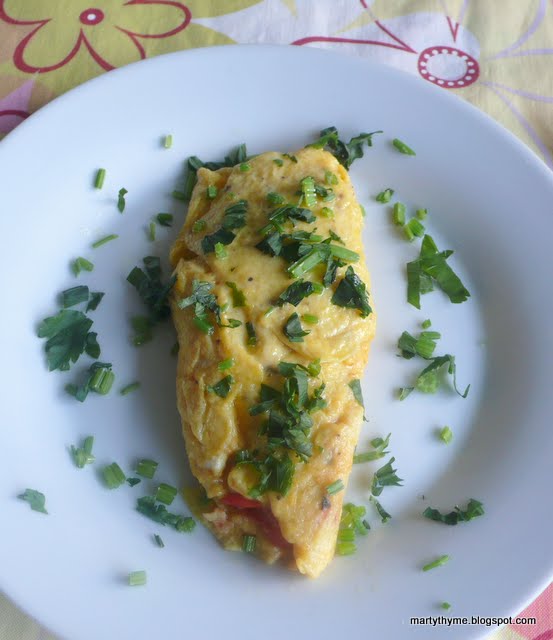
Rolled omelette
It's said that the perfect omelette is the mark of a great kitchen and a fine chef. Legend has it that famous French chef Escoffier challenged would-be cooks to prepare a perfect omelette. Those who succeeded earned a place in his kitchen.

The omelette was the last item on my Julia egg project. The previous ones ­­– on scrambling, poaching, and shirring and baking ­­– were easy compared to making omelettes. I had to do it three times before I got it right.

But it certainly was the most enjoyable method of cooking eggs. Not least because you really have to get tough with the eggs!

You have to move fast when making an omelette ­­– 30 seconds is all it takes from start to finish. This video from Julia Child's cooking programme, The French Chef, shows just how fast.

Julia Child advises that you not only read and memorise the recipe first, but she also suggests practising with a pan and half a cupful of dried beans to learn the proper technique of moving the eggs while they cook ­­–  you need to "flip them (the beans) over themselves in a group". The picture below shows what happens when you're not prepared:

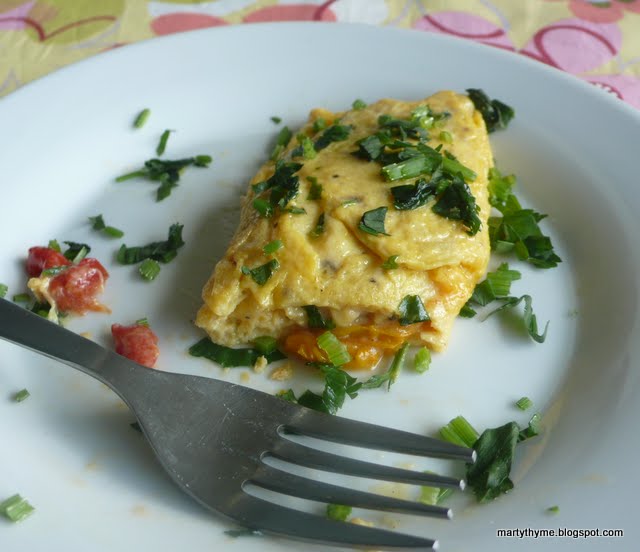
Good taste, but lacking in looks
I left the third attempt for a day later after initially spilling the beans all over the balcony but I finally managed to do a good flip and ended up making a decent enough omelette. I couldn't go another round anyway. That was my last egg...


Stuffed with marinated bell peppers
ROLLED OMELETTE
L'Omelette Roulée

For 1 omelette, 1-2 servings
Time: Less than 30 seconds of cooking

2 or 3 eggs
Big pinch of salt
Pinch of pepper
A mixing bowl
A fork
  • Beat the eggs and seasonings in the mixing bowl for 20-30 seconds until the whites and yolks are just blended. 
15g butter
An omelette pan 19cm in diameter at the bottom
A fork
  • Place the butter in the pan and place over very high heat. As the butter melts, tilt the pan in all directions to film the sides. When you see that the foam has almost subsided in the pan and the butter is on the point of colouring (indicating it is hot enough), pour in the eggs. It is of utmost importance in this method that the butter be of the correct temperature.
  • Let the eggs settle in the pan for 2 or 3 seconds to form a film of coagulated egg in the bottom of the pan.
  • Grasp the handle of the pan with both hands, thumbs on top, and immediately begin jerking the pan vigorously and roughly towards you at an even 20-degree angle over the heat, one jerk per second. It is the sharp pull of the pan towards you which throws the eggs against the far lip of the pan, then back over its bottom surface. You must have the courage to be rough or the eggs will not loosen themselves from the bottom of the pan. After several jerks, the eggs will begin to thicken. (A filling would go in at this point.)
  • Then increase the angle of the pan slightly, which will force the egg mass to roll over on itself with each jerk at the far lip of the pan.
  • As soon as the omelette has shaped up, hold it in the angle of the pan to brown the bottom a pale golden colour, but only for a second or two, for the eggs must not overcook. The centre of the omelette should remain soft and creamy. If the omelette is not formed neatly, push it with the back of your fork.
  • Turn the omelette on to the plate, rub the top with a bit of butter, and serve as soon as possible.
Garnishings and fillings for omelettes
HERBS: Beat into the eggs at the beginning 1 tablespoon of chopped fresh herbs. Sprinkle more of the same over the finished omelette.
CHEESE: After the eggs have set for 2 or 3 seconds in the pan, sprinkle 1 or 2 tablespoons of grated Swiss or Parmesan cheese and finish the omelette. If you wish, sprinkle more cheese over the completed omelette, dot with butter, and place quickly under a very hot grill to melt and brown the cheese.
SPINACH: Beat 2 or 3 tablespoons of cooked purée of spinach into the eggs at the beginning, then proceed with the omelette as usual.
Julia egg project: Shirred & baked

Wednesday, August 25, 2010

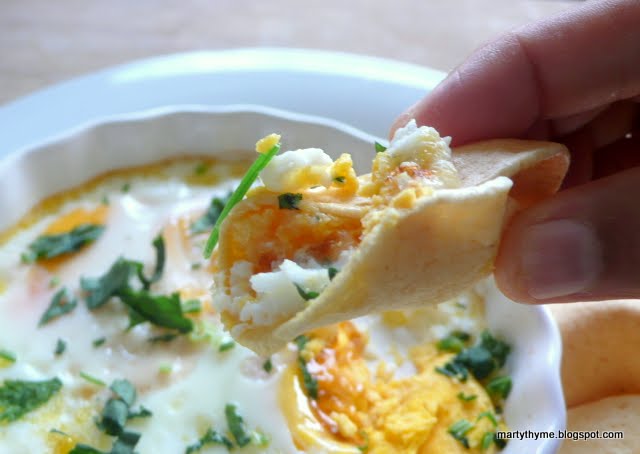
Shirred eggs and chips
The scrambled and poached eggs portion of the Julia egg project were a cinch compared to using the oven to cook eggs. I didn't do very well with these dishes at all.

Both the shirred (Oeufs sur le Plat) and baked (Oeufs en Cocotte) eggs came out a little overcooked and were firm when they were supposed to remain a little wobbly. I don't like runny eggs, but these would have never passed muster with the great Julia Child.

First the shirred egg. A shirred egg is one that is broken into a small, flat, buttered dish and cooked quickly under the grill. The white is softly set and tender, and the yolk is liquid, but covered by a shimmering, translucent film. In the recipe, the egg is broken into a heatproof dish ­­– a shallow ramekin is recommended ­­– which is then placed on the stove so the bottom cooks before the dish gets bunked in the oven to finish cooking.

I was a little scared to use my ramekin on the gas stove, even if it was just for 30 seconds. I didn't know if it could really stand the heat of an open flame. But as the saying goes, you can't make an omelette without breaking a few eggs (different egg dish, but you get the idea). So I put the ramekin on the flame and patiently kept it there fo 30 seconds.

Well, it survived... but then I made the mistake of keeping it too long under the grill...

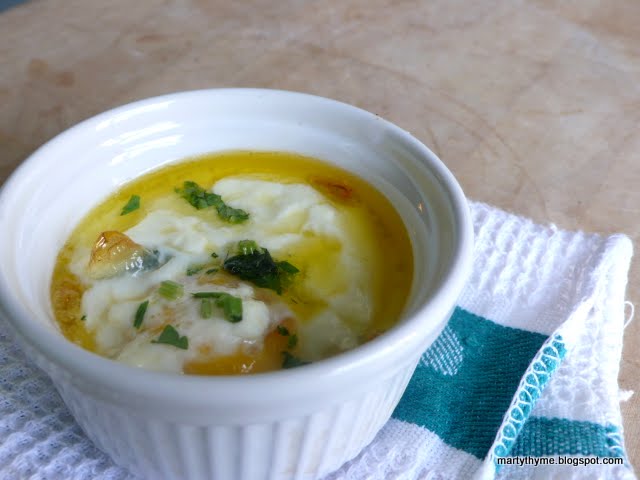
With the baked egg, I just didn't take it out of the oven soon enough and the top burnt. And I put too much butter in the dish so there's an oil slick on top of the eggs.

TOMORROW: The defining egg dish... The Omelette

Eggs from the grease pit
EGGS BAKED IN RAMEKINS
Oeufs en Cocotte

For each serving
  • Preheat oven to 190°C.
1 tsp butter
1 ramekin 6-7.5cm in diameter and about 3.5cm high
2 tablespoons cream
A pan containing 2cm of simmering water
1 or 2 eggs
Salt and pepper
  • Butter the ramekin, saving a dot for later. Add 1 tablespoon of cream and set the ramekin in the simmering water over moderate heat. When the cream is hot, break into it 1 or 2 eggs. pour the remaining spoonful of cream over the egg and top with a dot of butter.
  • Place in the middle level of the moderate oven and bake for 7-8 minutes. The eggs are done when they are just set but still tremble slightly in the ramekins. They will set a little more when the ramekins are removed, so they should not be overcooked. Season and serve.
Variations
  • Add a teaspoon of chopped herbs with the cream.
  • Put a spoonful or two of any of these cooked ingredients in the bottom of the ramekins along with the cream: chopped mushrooms or asparagus; diced lobster or shrimp
Uh-oh, the unbroken yolk got burnt
SHIRRED EGGS
Oeufs sur le Plat ­­– Oeufs Miroir

For each serving
  • Preheat grill to very hot.
A shallow, fireproof dish about 10cm in diameter
1 teaspoon butter
1 or 2 eggs
  • Place the dish over moderate heat and add the butter. As soon as it has melted, break the egg(s) into the dish and cook for about 30 seconds until a thin layer of white has set in the bottom of the dish. Remove from heat, tilt dish and baste the egg with the butter. Set aside.
Salt and pepper
  • A minute or so before serving, place the dish an inch below the hot grill. Slide it in and out every few seconds and baste the egg with the butter. In about a minute the white will be set, and the yolk filmed and glistening. Remove, season and serve immediately.
There are several suggestions given in the book to dress up the eggs, for example, with black butter sauce and browned with cheese, but I won't provide the recipes here. The eggs can also be surrounded with sautéed mushrooms, tomato sauce, sausages, "or whatever else strikes your fancy".

Julia egg project: Poached

Tuesday, August 24, 2010

Humpty Dumpty's cooked cousin has a broken heart
I had never poached an egg before this. I'm not a fan of runny yolks so there was never a need to cook eggs this way or have them half-boiled. But I had to do it in the interest of my Julia Child project where I test the egg recipes in Mastering the Art of French Cooking (I started with scrambled eggs yesterday and will continue with more over the next few days).

I can't say that I have taken a liking to runny yolks, but if anyone wanted their eggs poached, I could do that now.

This is what Julia Child says about the technique:
"The most important requirement for poaching is that the eggs be very fresh; the yolk stands high, the white clings to it in a cohesive mass and only a small amount of watery liquid falls away from the main body of the white. A stale egg with a relaxed and watery white is unpoachable because the white trails off in wisps in the water leaving the yolk exposed."
Here's her advice for eggs that are not that fresh:
"... simmer them in their shells for 8-10 seconds before poaching. This will often firm up the white just enough to make it hold its shape around the yolk when the egg is broken into the water."
I have read and seen TV chefs swirling the simmering water in their pans before putting the eggs in. That apparently helps keep the egg nice and round. This isn't Julia Child's method. I tried the swirling technique for one egg and the white floated all over the pan. Maybe the free-range eggs I used weren't as fresh as I thought (although look at that lovely yellow yolk!). But when I left the water alone for the other egg, it was easier to keep the white and yolk together. Mrs Child really did know what she was talking about. And to think, she didn't even know how to boil an egg when she got married.

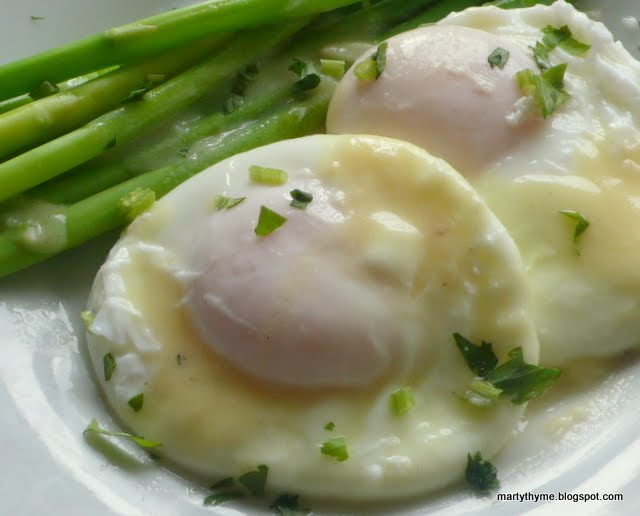
The poached eggs are pictured here with blanched asparagus and drizzled with a simple white sauce (not from the book).

TOMORROW: Shirred and baked


Before the break-up
POACHED EGGS
Oeufs Pochés
To transfer the egg from the shell to the water, you may either break it directly into the water or break it into a saucer, tilt the saucer directly over the water and slip the egg in.
Cooking time: 4 minutes per egg

A saucepan or deep frying pan (I use a wok)
Vinegar (which helps the eggs hold their shape)
  • Pour 5cm of water into the pan and add 1 tablespoon of vinegar for every 500ml of water. Bring to a simmering point.
4 very fresh eggs
A wooden spoon or spatula
A slotted spoon
  • Break an egg and slip in into the water. Immediately and gently push the white over the yolk with a wooden spoon for 2-3 seconds. Maintain the water at barely simmering point and proceed with the other eggs in the same manner.
A bowl of cold water
  • After 4 minutes, remove the first egg with the slotted spoon and test with your finger. The white should be set, the yolk still soft to the touch. Place the egg in the cold water; this washes off the vinegar and stops the cooking. Remove the rest of the eggs as they are done, and poach others in the same water if you are doing more.
WHITE SAUCE
1 clove garlic, finely minced
1 teaspoon butter
1 cup water
1 teaspoon concentrated chicken stock (or ½ vegetable stock cube)
½ teaspoon cornflour mixed with 1 tablespoon water
Pepper
  • In a saucepan over medium heat, melt butter. Add garlic and stir for 30 seconds. Add water and concentrated stock. Bring to a boil. Turn down heat and stir in cornflour solution to thicken sauce; season. Drizzle over eggs and asparagus.