The Oven has baked its last loaf. This blog is no longer being updated.

My cooking videos appear at youtube.com/janeragavan

I write on food at star2.com

Mince and rat's tail noodles

Wednesday, September 8, 2010

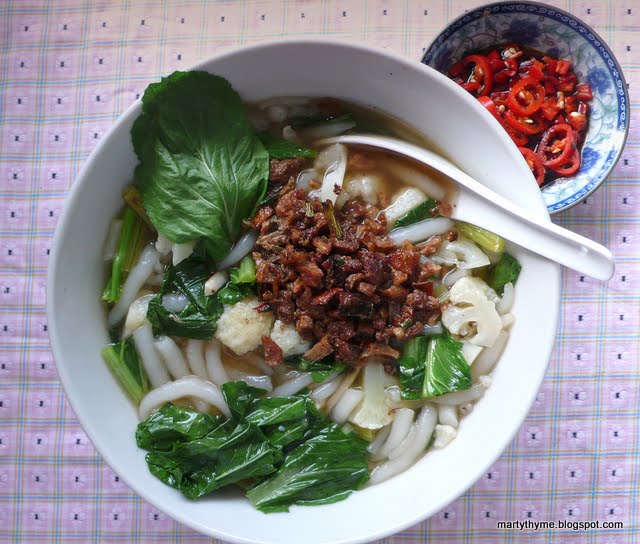
Minced beef with loh shi fun
Oh no no, don't misread the title of this post. That's mince AND rat's tails noodles. The noodles are called that in Chinese – loh shi fun – because of their shape: short and fat and resembling a rodent's end zone.


This is the first time I am cooking with the rice noodle, and it also happens to be the first time I am eating it!

I've seen it prepared by hawkers, but have never been persuaded to eat it, preferring instead to have the more conventional kueh teow or yellow mee. It isn't a prejudice; I just never thought about it.

At my neighbourhood grocers the other day, it was there along with the other noodles and I thought, why not? I was in the mood for a soup and I could use it and see what happens.

And now, I think I'm in love with this noodle.

It's so easy to eat! I have no problem using chopsticks but because these noodles are short, I can just use a Chinese soup spoon while I sit in front of the TV ­­– no spillover, splashes or mess, and I get a few noodles, the condiments and the all-important broth all in one scoop.

The broth I made for the following recipe was nothing out of the ordinary – a spoonful of stock concentrate added to water to get chicken-flavoured soup. I made it special for myself with hot minced beef.

Because I used only a small amount of meat, and it was left over from a dish I had to prepare for a cookbook review, I minced it up myself by hand. When I was little, I remember how my maternal great uncle used to mince great hunks of meat on special days when he fed a large crowd. He was a headmaster but was the most fantastic cook. He lived next door to us, in one compound, so when we knew he was cooking his amazing curry mee or braised pork slices with yam, we would eagerly wait for him to holler from across the hedge, "Makan!" and we would all scoot over.

It was fascinating to watch Great Uncle Ben mince meat. He would put a slab of pork or beef on one of those thick wooden chopping blocks cut from a tree trunk, slice them using a cleaver, and tenderise them first using  the dull edge of the knife. Next, he would pound away as he flattened the meat into one lean layer. Then he would fold one side of the meat layer onto itself, slide the knife blade beneath it, deftly give it a quarter turn and then on with more chopping, repeating the process until he got the mince as fine as he needed.

LOH SHI FUN SOUP WITH SPICY MINCED MEAT Serves 2

100g loh shi fun
2 teaspoon sesame oil
600ml water
1 tablespoon chicken stock concentrate
1 large clove garlic, thinly sliced
100g vegetables (mustard green, cauliflower, beans etc), cut into small pieces
Cooking oil
Sliced red chillies and soy sauce 

Minced meat
100g meat (beef, pork or chicken), cubed
1 small shallot, chopped
1 tablespoon thick soy sauce
Large pinch of chilli flakes
Freshly ground black pepper
1 teaspoon sesame oil
Soy sauce to taste
  • Mix loh shi fun noodles with thick soy sauce and sesame oil; set aside.
  • Prepare the mince. Place the cubes of meat on a cutting board; using a cleaver or heavy chef's knife, mince the meat coarsely (do this manually so you don't get finely ground meat). Spread the mince out on the board and sprinkle with the chopped shallot, thick soy sauce, chilli flakes and black pepper to taste. Drizzle with sesame oil and soy sauce. Fold the meat onto itself and continue chopping, incorporating the seasonings. Place meat in a bowl and set aside for 10 minutes.
  • In a saucepan, heat 2 tablespoons cooking oil over medium high heat and then add meat. Cook until the meat is brown and crisp, 3-5 minutes. Remove meat and set aside.
  • Add more oil to the pan if necessary and fry the garlic until lightly browned. Add water and stock concentrate (or use real stock if desired) and bring to the boil. Add vegetables and cook until softened, then add noodles. Season to taste. Pour into bowls; garnish with the minced meat and serve immediately with sliced red chillies and soy sauce.
PRINTABLE RECIPE

Malay kuih from the old days

Sunday, September 5, 2010

Boarding school tea cakes
This kuih may not be the prettiest thing you've seen but I love it for the taste and because it reminds me so much of my childhood, especially the seven years I spent in fully residential school (boarding school).


It's called Tepung Gomak. The filling is made of mung beans (the greenish tinge is the result of the green skin of the bean), grated coconut and sugar. It is encased in a dough made simply from glutinous rice flour and water. The patty is cooked by poaching and then rolled in mung bean flour.

When I saw this recipe in Norzailina Nordin's cookbook Bite Size: A Collection of Traditional Malay Treats (2009, Marshall-Cavendish, RM39.90), I got quite excited. It's not a Malay tea cake that I have seen since my girlhood in Perlis (the northernmost state in Peninsular Malaysia). Actually, there are quite a number of kuih in the book that I only remember having when I was young and which I can no longer find nowadays.

One of my classmates used to sell Sagon, a simple mixture of toasted grated coconut, rice flour and sugar. After the weekends she spent at home in her kampung, she would bring back Sagon ­­– think of it as Asian trail mix ­­– in little cone packets made from newspaper that she sold for 20 sen each. While we easily get rice flour nowadays, at the time, her mother would pound husked rice in a lesung tangan, one of those huge wooden mortars that sits on the ground and comes with an equally huge pestle ­­– pounding was usually a two-person job and they would do it in rhythm; one pestle would go in and as it was lifted out, the other one would go in, and so on. Very efficient. (For pictures, go to this website.)

I featured Pulut Serunding for this month's Don't Call Me Chef (see tab above; the link to the published document will be up soon is now up ­­– click here) since the theme was a celebration of Hari Raya Aidil Fitri. I like anything with glutinous rice and coconut and this kuih combines the two so I had a good time making and eating it. There was a little of the pulut and serunding left over and the next day, I didn't bother with the banana leaf cones.

What are your favourite kuih from the old days? Can you still find them easily nowadays?

TEPUNG GOMAK(Green Bean Flour-Coated Patties)
Adapted from Bite Size
Makes 10

2 shredded and knotted screwpine (pandan) leaves
200g green (mung) bean flour

Filling
100g mung beans
60g soft dark brown sugar
30g caster sugar
80g grated coconut

Dough
240g glutinous rice flour
1/4 teaspoon salt
200-250ml water
  • Prepare filling. Boil green beans until tender and broken up. Strain off water. Return beans to pan.
  • Add the other filling ingredients and stir over medium heat until quite dry but still moist. Remove from heat and leave to cool.
  • Prepare dough. Combine glutinous flour and salt. Add water, a little at a time, and mix into a soft, pliable dough.
  • Divide dough into 10 portions. Flatten one portion with your hands and spoon filling into the middle. Enclose to make a 4cm ball. Flatten into a 1cm-thick patty.
  • In a large pan, bring some water and the screwpine leaves to the boil. Drop patties in batches into the boiling water. When they start to float, remove with a slotted spoon and drain well.
  • Roll patties in green bean flour before serving.
SAGON
Sweet Coconut Floss
Serves 6

195g grated skinned coconut
250g rice flour
110-120g caster (superfine) sugar
  • In a large pan, stir grated coconut over very low heat until very pale cream in colour.
  • Add rice flour and continue to stir for 15-20 minutes more. When the mixture is very dry, fragrant and crisp, remove from heat. tip into a bowl and set aside to cool before mixing in the sugar to taste.
    PRINTABLE RECIPES

    Daring Bakers: Baked Alaska

    Tuesday, August 31, 2010

    Our first home
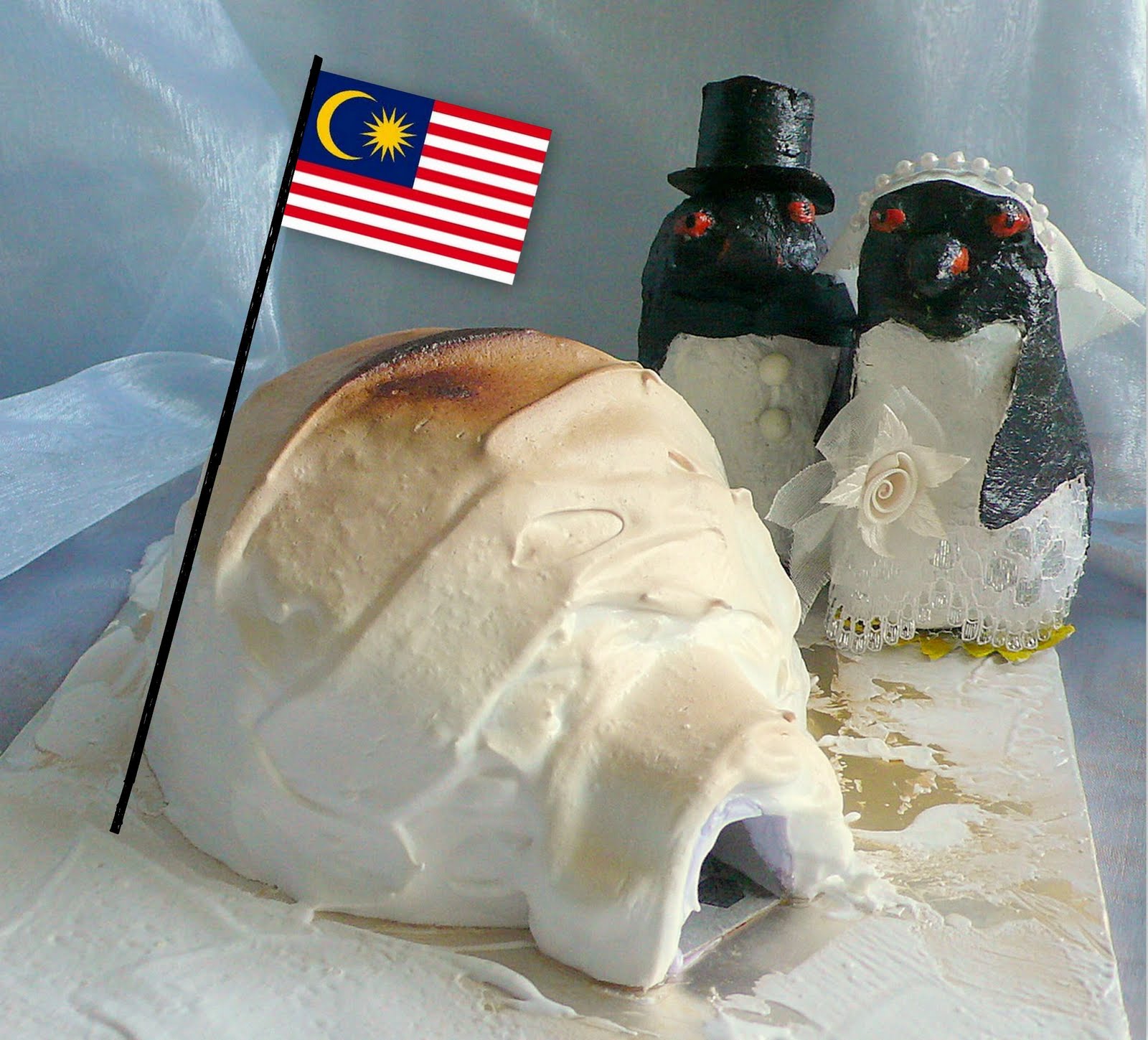
    Today is Malaysia's National Day. The country is 53 this year. I've had nothing to do with any of the events that are taking place, so I cannot use that as an excuse for posting late on this month's Daring Bakers challenge. I've simply been trying to play catch-up with things in life, though by the looks of the picture, it might seem as if I just have too much time on my hands! 

    The August 2010 Daring Bakers’ challenge was hosted by Elissa of 17 and Baking. For the first time, The Daring Bakers partnered with Sugar High Fridays for a co-event and Elissa was the gracious hostess of both. Using the theme of beurre noisette, or browned butter, Elissa chose to challenge Daring Bakers to make a pound cake to be used in either a Baked Alaska or in Ice Cream Petit Fours. The sources for Elissa’s challenge were Gourmet magazine and David Lebovitz’s The Perfect Scoop.

    You will find the recipe in pdf form here. And please visit the Daring Bakers website for all the creative work done by the other Daring Bakers who took part.

    I decided to make the Baked Alaska. Why? Because as soon as I read "Baked Alaska", I thought of this pair of papier mâche penguins I had made to illustrate crafts on wedding gifts some time ago, so snow, ice... IGLOOS! The penguins would fit perfectly into the tableau.

    You can tell I like to play with my food.

    Crack, whip, ice, and finally the burnt butter
    The vanilla ice cream is from the last Daring Bakers challenge. A month has passed and there's still so much left over so I was quite glad this month's challenge involved ice cream again.

    I used the oven to brown the meringue but as you can see, it didn't toast all over. The igloo sat on a cake board but it was a little fiddly doing the browning in the oven since I couldn't manoeuvre the base very well.